
More character or just more volume? How to judge saturation in a mix
Harmonic saturation audio can be convincing within seconds. Insert a saturator, increase the processing slightly and the signal seems to come alive: more presence, more density, perhaps a greater sense of solidity.
Then hit bypass.
The processed version sounds better.
That is exactly the moment when it is worth being a little suspicious of the first impression.
Not because the saturation is necessarily doing anything wrong. It may be doing exactly what you want. The problem is that while the signal changes, the way we perceive its level can change as well. And a slightly louder signal has a significant advantage in a quick comparison.
That leads to a more useful question than the usual “how much saturation should I use?" : are we really preferring the character introduced by the processing, or are we at least partly preferring more volume?
Louder almost always sounds better
Saturation is one of those processes that can create an immediate sense of gratification. The material moves forward in the mix, gains consistency and seems to carry more energy. The comparison with bypass can feel almost obvious.
But an A/B comparison is not automatically reliable just because we can press a button.
If the processed signal reaches our ears at a higher perceived level, we are comparing two things at the same time: what the saturation has changed and the difference in volume.
Separating the two is not always intuitive.
The subject becomes even more interesting because saturation is not a single, fixed effect that always sounds the same. Non-linear behaviour can introduce harmonic components and alter the way peaks and transients behave. How obvious those changes become depends on the processor, the source, the level and the amount of processing.
That is why words such as “warmth”, “density” or “presence” may describe a listening impression, but tell us relatively little about what is actually happening.
Before deciding whether we like the result, it helps to understand where that difference is coming from.
Level is part of the process
With a non-linear processor, hitting the input harder does not necessarily mean simply getting a louder output.
It can mean driving the process into a different operating range.
When working with harmonic saturation audio, gain staging is therefore not just a precaution against overload. It becomes part of the creative decision.
Take an electric bass. At a certain input level, the processing may remain relatively subtle; increase the level feeding the processor and its effect can become progressively more noticeable.
A synth presents very different material to the same process. A drum bus involves a group of transients and internal relationships that have already been shaped. By the time we reach the mix bus, every change affects a much broader balance.
The position of a control, on its own, therefore tells only part of the story.
The other part lies in the signal being fed into the processor.
This also explains why a setting found quickly in one session may behave very differently in the next. If the starting level changes, we are not necessarily asking the processor to behave in the same way.
The real problem begins when input level, amount of processing and output level are adjusted almost simultaneously. The result changes in several directions at once, and the ear has to decide which of those differences it actually prefers.
That is where volume can become a rather biased judge.
The comparison that changes the decision
Level matching is often associated with technical tests or highly controlled comparisons. With harmonic saturation audio, however, it is also a very useful tool in everyday work.
It does not make the processed and unprocessed signals identical. It simply reduces the chance that volume will make the decision for us.
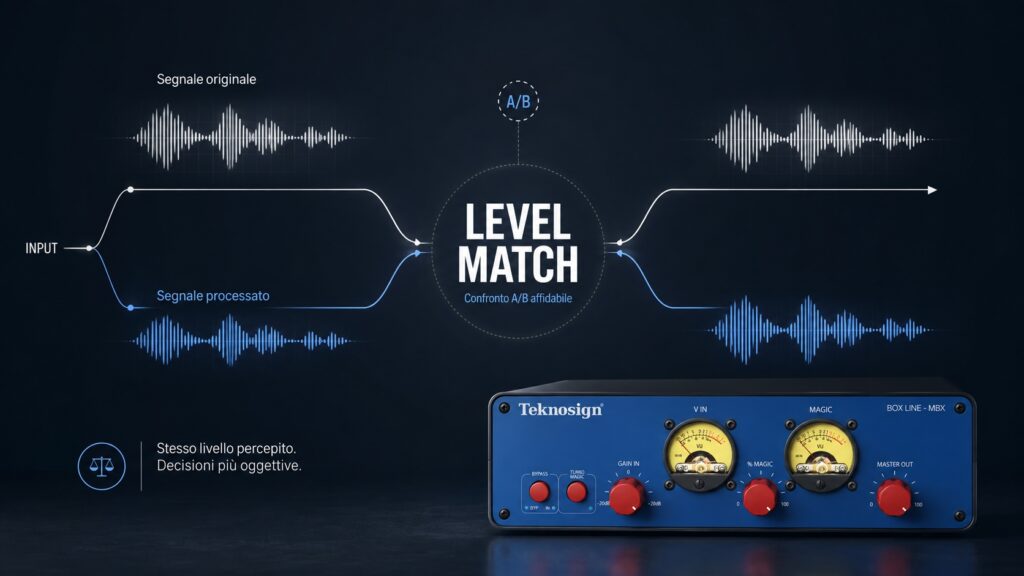
Once you have found a setting that sounds interesting, bringing the processed signal back to a perceived level close to the bypassed version can change the evaluation considerably.
Sometimes it confirms the choice immediately. The processing still works even without the advantage of extra volume.
Other times, the initial “wow” becomes much smaller.
That is just as useful a result.
With an electric bass, what first seemed like extra body may have been largely caused by increased level. Or, once the volume is matched, something genuinely useful may remain: better definition in the mix, peak behaviour that suits the track more closely, or a distribution of energy that works better alongside the other instruments.
On a drum bus, the line can become even finer. More obvious processing may immediately create a sense of density, but after level matching we may realise that some of the contrast that made the drums effective has disappeared.
By the time we reach the mix bus, the decision becomes more delicate again. We are no longer changing a single source, but many relationships that have already been built.
That is why “more harmonics” cannot automatically mean “a better mix”.
Sometimes the right amount of processing is obvious. At other times it is barely perceptible.
And sometimes bypass really does win.
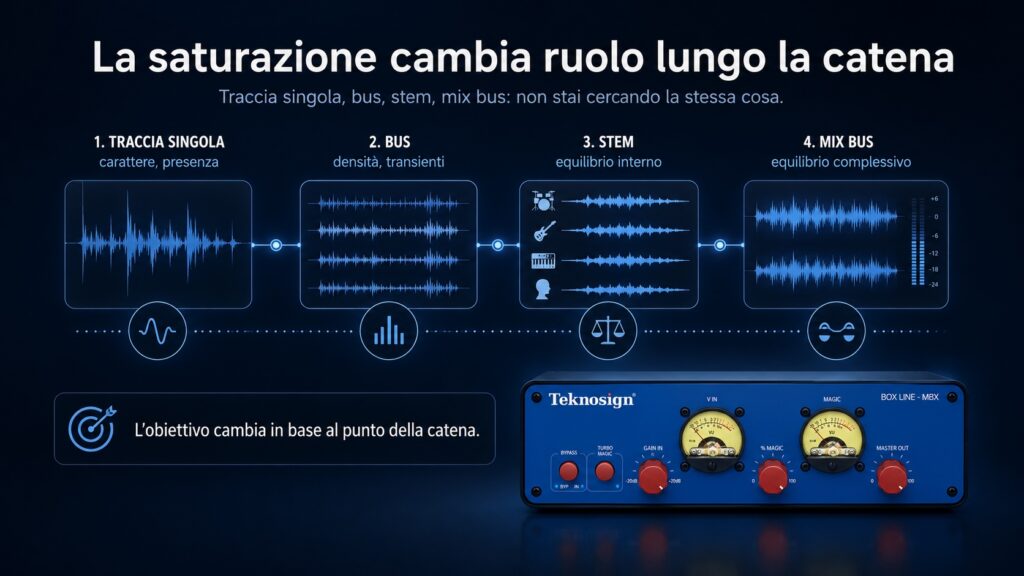
Saturation changes role along the signal chain
There is another aspect that tends to get lost when saturation is discussed in general terms: we are not looking for the same result on an individual source, a stem and the complete mix. non stiamo cercando la stessa cosa su una sorgente, su uno stem e sul mix completo.
On a single track there is usually more freedom to shape character. We may want to alter the presence of a bass, the behaviour of a synth or the consistency of an already-preamplified vocal.
On a bus, the processing begins to affect the relationship between several elements. The question is no longer simply “do I like this sound?” but also “what is happening to the balance I had already built?”
A stem takes that reasoning another step further.
On the mix bus, even a relatively small change affects the whole programme. What sounds attractive in the first few seconds still has to work when we return to the overall dynamics, articulation and internal relationships of the mix.
There is therefore no universally correct amount of saturation.
There is an objective.
And there is a point in the chain where we decide to pursue it.
When saturation leaves the DAW
Bringing harmonic saturation audio into a hardware or hybrid workflow does not change the principle. If anything, it makes the importance of the signal path even more obvious.
The signal leaves the interface, reaches the hardware and returns to conversion. Output level, processor input, amount of processing and return level all become parts of the same system.
MBX in the hardware path
This is where MBX finds its place within the Teknosign range.
MBX is a stereo saturator designed to work with signals that are already at line level. It can be inserted in the path of an already-preamplified vocal, a bass or a synth, but it can also be used on buses, stems and the mix bus.
These are very different uses, which is exactly why searching for one universally “correct” setting would make little sense.
With an electric bass, the focus may be on how the source sits in the mix. On a drum bus, the focus may shift to the balance between consistency and transient behaviour. A stem, by contrast, requires attention to the clarity of the individual elements it contains. By the time we reach the mix bus, the focus inevitably shifts to the overall balance.
The criterion remains the same: what are we trying to achieve at that point in the chain, and what remains of the result once the comparison becomes reliable again?
This also avoids another common shortcut in the language surrounding saturation: treating terms such as warmth, depth or three-dimensionality as automatic consequences of inserting a processor.
Those descriptions can be perfectly valid listening impressions in a specific situation. They are not, however, guaranteed properties of saturation itself.
It is much more useful to observe what actually happens in the workflow.
Does the bass guitar sit more clearly in the mix, or is it simply louder? With a synthdoes the processing genuinely improve how it integrates with the arrangement, or does it remove contrast that the track actually needed? On a bus, does consistency increase without sacrificing too much transient behaviour or dynamics? And on the full mix, does the processing still make sense once the level has been matched again?
Those are the differences worth keeping.
The initial “wow” has to survive bypass
Saturation works well when it stops being a recipe and becomes a deliberate variable within the mix.
Sometimes it can be obvious. In other cases it may be barely noticeable. It depends on the source, the point in the chain, the level and, most importantly, what we are trying to achieve.
The risk is falling in love with the first impression too quickly.
That is why, after finding a setting that seems to work, it is always worth taking one final step: compensate the level and return to bypass.
If the processed version still sounds more convincing, then you have probably found something worth keeping.
If the difference suddenly loses much of its appeal, no time has been wasted. You have simply discovered that part of the result you were attributing to saturation actually belonged to volume.
A few seconds of comparison can completely change a decision.
And very often, those few seconds are what separate a treatment that impresses from one that genuinely works in the mix.
When volume stops making the decision
Harmonic saturation audio can significantly alter a source, a bus, a stem or an entire mix. Precisely because the result can be immediately appealing, it is worth avoiding decisions that are made too quickly.
The level feeding the processor matters. The amount of processing matters. The level returning to the monitoring chain matters.
When everything changes at once, it becomes difficult to know which difference we are actually preferring.
Level matching does not make the process less creative. It simply makes it easier to hear what the processing is really doing.
And that is where a more informed decision can begin.
If you are considering where to insert a saturation processor in your hardware or hybrid chain, write to info@teknosign.it and tell us about the source, the signal path and the point where you would like to intervene
We can discuss how MBX could be integrated into your workflow.