
Hybrid mastering: routing, levels and recall before chasing “analog sound”
Adding an equalizer, saturator or another hardware processor to a mastering chain is relatively straightforward. You route the signal out of the DAW, through the outboard and record the result back in.
The less obvious part comes next: understanding exactly what is changing what you hear.
As soon as the signal leaves the DAW, conversion, levels and latency all come into play. If the project needs to be reopened later, being able to recreate the same setup matters too.
In hybrid mastering, where relatively small differences can be significant, these are not just organizational details. They can directly affect the comparison.
The character of the hardware matters. But it makes much more sense to judge it when everything around it is under control.
You are not just adding a processor
Writing:
DAW → hardware → DAW
is useful as a simple overview, but it hides several important stages.
The actual path is closer to:
DAW → D/A → line output → hardware → line input → A/D → DAW
Before reaching the outboard, the digital signal must be converted to analog. After processing, it has to make the reverse journey before returning to the session.
This does not mean you necessarily need two separate devices. In many setups, the same audio interface handles both conversions. The signal leaves through its line outputs and returns through its line inputs. Dedicated D/A and A/D converters can of course be part of more elaborate systems, but they are not a requirement for hybrid mastering.
The distinction still matters because it makes something clear that a simple DAW–hardware–DAW diagram tends to hide: the processor is only one part of the signal path.
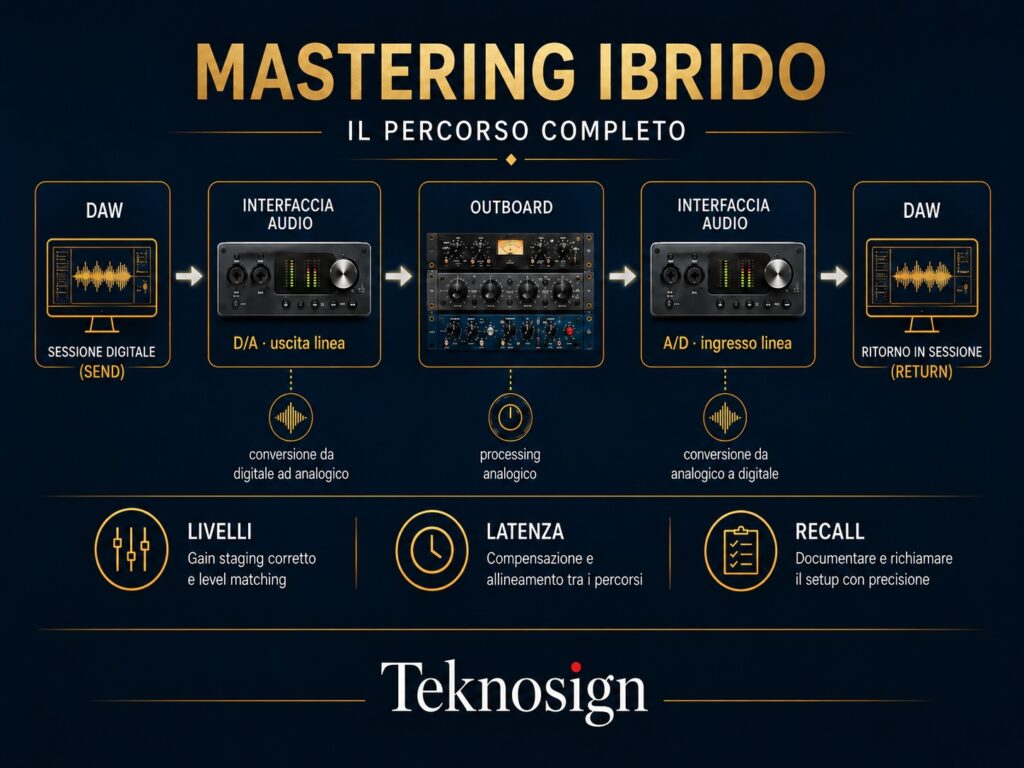
The level you send to the hardware is part of the result
One of the easiest mistakes is to keep looking only at the DAW meter.
Once the signal leaves the converter, the digital level in the session is related to a real electrical level. That relationship depends on the calibration of the conversion system, so there is no universal correspondence between a specific dBFS value and a specific dBu level.
The useful question is much simpler: At what level am I actually driving the processor?
This is not just about headroom. Some processors can respond differently depending on the level they receive, so changing the gain staging can also change the way the processing behaves.
Then there is the comparison itself.
If the processed signal returns to the DAW noticeably louder than the original, that increase in level can easily be perceived as an improvement. This is why level matching, comparing signals at as close as possible to the same perceived level, is part of the method.
Non occorre trasformare una sessione di mastering in un laboratorio di misura. Occorre però sapere da dove si è usciti, dove si è rientrati e se il confronto tra originale e processato è realmente attendibile.
A mastering session does not need to become a measurement laboratory. But you should know where the signal left the system, where it returned and whether the comparison between original and processed versions is genuinely reliable.
Latency: when it is just time, and when it becomes alignment
In hybrid mastering, every trip out of the DAW through conversion and hardware takes time before the signal returns to the system.
In a fully serial stereo chain, stable latency is mainly a matter of placing the returned signal correctly in time.
Things become more delicate when the processed signal is combined with another path that has not made the same journey.
In parallel processing, a timing difference can also become an alignment issue. At that point, it is no longer only about “when” the signal returns. It is also about how the two paths interact when they are summed together again.
Not every DAW and audio interface handles an external insert in exactly the same way. Compensation and behaviour should therefore be checked on the system you are actually using rather than relying on a supposedly universal procedure.
We will go deeper into this in our dedicated article on external inserts in the DAW, covering send, return, I/O and latency compensation.external insert nella DAW, con send, return, I/O e compensazione della latenza.
Hardware recall: being able to reopen the job properly
With plugins, we are used to closing a session and finding almost everything where we left it when we open the project again.
Hardware can require a different approach.
A photo of the front panel may be enough to remember a setting. In a more complex chain, however, it does not tell the whole story. Which interface outputs were used? Where did the signal return? In what order were the processors connected? What were the send and return levels?
A small amount of information can make hardware recall far more reliable: hardware settings, I/O used, processing order, levels and master version.
The way signal paths are named helps as well. “Out 5-6” may seem perfectly clear during the session and mean very little six months later. A name that describes the function — for example, a dedicated stereo hardware processing path — makes the session much easier to understand when you return to it.

A well-designed session sheet should not add bureaucracy. It should prevent it when a revision arrives and you would otherwise have to rebuild from scratch a chain that was already working correctly.
Before choosing the hardware, define the job
In hybrid mastering, once routing, levels and recall are clear, even the question “which processor should I use?” becomes more useful.
You are no longer looking for something that will generically make the master sound “more analog”. You are looking for a specific function.
You may want to adjust the overall tonal balance. You may want to introduce saturation. Or your stereo signal may originate from a stem-based mix that leaves the DAW before the final stage.
These are different requirements, and they call for different tools.
This is also the most useful way to look at different Teknosign solutions within a hybrid setup: not as a mandatory chain, but as tools with clearly defined roles.
BEQ — stereo tonal shaping
BEQ is a Stereo BAX EQ for balanced line-level signals, designed for broad tonal adjustments on buses, stems, stereo mixes and hybrid mastering chains.
Its role is not surgical, very narrow corrective EQ. It is more relevant when the aim is to work on the overall tonal balance of stereo material.
In a mastering context, BEQ therefore has a clear role when the task is to refine overall tonal balance rather than target a problematic frequency with a highly selective correction.
MBX — stereo saturation
MBX serves a different purpose. It is a stereo saturator for line-level signals and can also be used on stems and the mix bus within a hardware or hybrid chain.
Gain staging deserves particular attention here. If the level entering the processing changes, what you are evaluating can change as well.
This is why a level-matched comparison is particularly useful: it helps separate the contribution of saturation from the simple perceptual effect of a louder signal.
MBX therefore makes sense when saturation is an intentional choice based on the material and the goal of the processing — not because every mastering chain necessarily needs it.
SUM CLASSIC — when the stereo mix starts from stems
SUM CLASSIC normally occupies a different position in the signal path.
It is a 16-channel summing mixer with level and PAN control on each channel, designed to bring stems out of the DAW and build the stereo sum. Its output can then be sent to an A/D converter, a master recorder or a subsequent stereo processing chain.
For this reason, SUM CLASSIC should not be seen as a mastering processor applied to an already completed stereo file.
Its role comes earlier. It can be the point where a stem-based mix becomes the stereo signal that will then be recorded or sent through further processing.
This distinction matters because it prevents very different tools from being grouped together under the single label of “mastering”.
Hybrid mastering: a good chain is one you can recreate
Hybrid mastering does not prove that hardware is automatically superior to digital processing.
Software and hardware can work very well together when each element has a precise role.
Before judging the character introduced by a processor, however, you need to know the conditions under which it is working. Input level, conversion, routing, return level and comparison should be stable enough to let you understand what has actually changed.
When those conditions can also be recalled, the whole system becomes much more robust.
A professional chain is not defined by the number of devices in the rack. It is also defined by knowing why each element is there, what it is doing and how to recreate the same conditions when the job requires it.
That is when the character of the hardware becomes something you can genuinely evaluate, rather than just another variable that is difficult to separate from everything else.
Consider BEQ for stereo tonal shaping
If your goal is to work on the overall tonal balance of buses, stems or stereo mixes, BEQ is the Teknosign solution most directly related to this task.
Consider BEQ for stereo tonal shaping
Other tools mentioned in this article
MBX — Stereo Saturator
SUM CLASSIC — 16-channel Summing Mixer