
Active or passive DI? How to choose the right one
A passive bass arrives on stage. A little later, an acoustic guitar with a piezo pickup, then a stereo workstation. The question seems to be the same every time: active or passive DI?
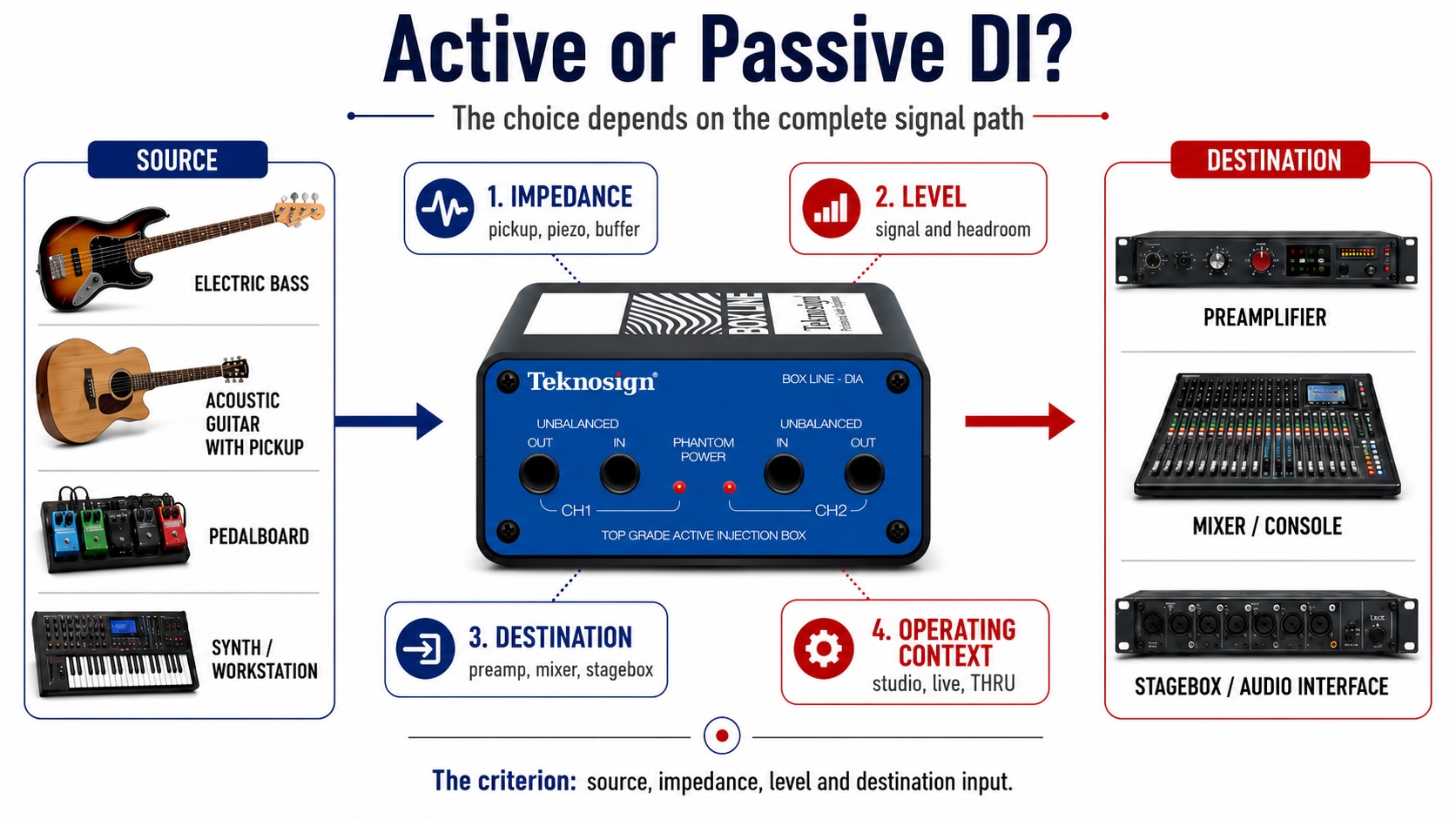
The quick answer would be to associate each source with a category. It is convenient, but it does not always lead to the best choice. A Direct Box sits between two devices: on one side is the source, with its output level and impedance; on the other is a preamp, stagebox, mixer or interface that must receive that signal.
The context changes the priorities as well. In the studio, a repeatable signal path may matter most; on stage, long cable runs, fast instrument changes, amplifiers that must remain in the chain and stereo sources can all affect the routing decision.
That is why the useful question does not stop at “active or passive?”. It is better to read the whole path:
source → DI → preamp, mixer or interface
The source alone is not enough
A common rule automatically pairs an active DI with passive instruments and a passive DI with active sources. It can be a useful first orientation, but in real-world work it quickly loses precision.
Two passive basses can have different pickups and different electrical behaviour. An acoustic guitar with a piezo pickup may be more sensitive to loading than a magnetic pickup. If a buffered pedalboard sits between the instrument and the DI, what reaches the input no longer behaves like the instrument connected directly.
Even “synth” is too broad a label. Synthesizers, workstations and drum machines can deliver output levels very different from those of a passive instrument. In that case, available headroom may become the main issue before the active-versus-passive architecture even enters the discussion.
The decision becomes more reliable when four aspects are checked, in this order.
Four checks before choosing a DI
1. Source impedance
The DI input is the load seen by the instrument. If that load is not appropriate for the source, the signal behaviour can change before it even reaches the mixer.
There is no need to chase a universal ratio: the important point is that passive pickups, piezo elements, active electronics and buffered outputs do not react in the same way. When the source is particularly sensitive to loading, an active input stage can be a coherent choice. If the output is already buffered and able to drive the expected load, a passive DI can work perfectly well.
When in doubt, “bass” or “guitar” tells you less than the source’s actual output impedance and the DI’s specified input impedance.
2. Level and operating headroom
Then there is level. A traditional pickup, an onboard preamp, a boost pedal and a line output can hit the DI with very different signal levels.
A DI that is well matched in terms of impedance can still be pushed too hard by an excessive input level. This is where the Pad becomes an operational tool: it attenuates the incoming signal and restores headroom when the source is hot. It is not a “tone” control to engage by habit.
If the signal arrives harsh or distorted, before attributing a sonic character to the DI it is worth checking the source output level, the Pad setting and the gain of the following preamp. On stage, where very different instruments and outputs may alternate within minutes, this check prevents a lot of trial and error.
3. Destination input
The DI does not end the chain. Its output is received by a microphone preamp, console, stagebox or interface. That input also contributes to how the system operates.
An effective choice therefore considers both sides: the DI must interface correctly with the source and deliver a manageable signal to the next stage. Impedance, headroom and available gain should be read as parts of the same signal path.
In live work this becomes especially concrete: the same source may encounter different consoles, stageboxes and cable runs from one date to the next. In the studio the hardware changes, but the principle remains the same.
4. Operating context
How the DI will be used can influence the choice just as much as the electrical specifications. A stereo synth, two independent instruments or a dual-mono setup require different management from a single mono source. On stage, the musician’s amplifier may need to stay connected; in the studio, repeatable cabling may matter more.
When available, THRU creates a parallel path to an amplifier or another device. It does not automatically “improve” the signal: it solves a routing need. The number of channels should also follow a real requirement, not simply the availability of more inputs.
Active and passive DI: what actually changes
An active DI uses a powered electronic stage to handle the input signal. A passive DI does not use a powered active input stage and, in transformer-based designs, relies on the transformer for a central part of the interfacing and isolation process.
That architectural difference matters, but it does not justify shortcuts about sound. “Active” does not automatically mean more transparent or detailed; “passive” does not automatically mean warmer or more musical. Circuit, transformer, impedances, level, load and operating conditions all interact.
A more useful question is therefore which architecture operates under the most suitable conditions within the actual signal chain.
Four situations that change the decision
With a passive bass, pickup behaviour and input loading matter more than the “passive” label itself. An active DI can be a coherent choice, especially when the source is load-sensitive, but the decision should still be checked against the real signal path.
With an active bass or a buffered pedalboard, output impedance may be lower while signal level can be higher. In that case, available headroom and the presence of a Pad may matter more than the active/passive classification.
With a synthesizer, check the output level and whether the connection will be mono or stereo. An output generically labelled “line” should not be treated like a pickup signal.
With a guitar or bass that must continue feeding an amplifier on stage, THRU can become decisive: the sound engineer receives the balanced signal while the musician keeps the path to the amplifier.
These are examples, not a universal table. Their purpose is to show which questions to ask before reaching for the first available DI.
Pad, Ground Lift and THRU solve different problems
These three controls often appear on the same panel, but they address different issues.
The Pad manages level and is used when more input headroom is required. Ground Lift acts on the ground connection provided by the DI and can be useful when a ground loop is present in the audio path. It does not automatically eliminate hum, buzz or interference: if the noise remains, the signal chain needs to be diagnosed again.
THRU, by contrast, is a routing function. It keeps a parallel path to an amplifier or another device while the balanced output continues towards the mixer, stagebox or recording system.
One final distinction matters: a DI Ground Lift has nothing to do with removing or bypassing the protective earth of mains-powered equipment, which must never be defeated.
DIA and DIP: two Teknosign approaches
Within the Teknosign Box Line, DIA and DIP translate this method into two dual-channel solutions built around different architectures.
DIA is a dual-channel active Direct Box. It provides two independent signal paths, a -20 dB Pad, Ground Lift, EMI/RFI filtering, a 10 kHz High Cut filter and a custom transformer. The specified input impedance is 100 kΩ unbalanced; the output is 150 Ω balanced.
DIP is a dual-channel passive Direct Box with a custom transformer. It includes a -20 dB Pad, Ground Lift, EMI/RFI filtering and a THRU output. The specified input impedance is 140 kΩ unbalanced; the output is 150 Ω balanced.
These numbers are not there to create a ranking between the two models. They help place DIA and DIP inside the real signal path: source type, available level, destination and routing requirements.
The dual-channel format makes sense with a stereo synth, two instruments, two independent lines or live situations where keeping two channels together in a single chassis simplifies management. If only one line is needed, channel count should not become the deciding factor on its own.
Choosing an active or passive DI becomes much easier once you stop starting from a recipe and start reading the signal flow.
Impedance helps you understand how the source will see the input. Level tells you how much headroom is required. The destination clarifies what the DI must feed. The operating context determines whether Pad, THRU, Ground Lift, two channels or a particularly long cable run become relevant.
On stage, this means being prepared when instruments, backline and stageboxes change. In the studio, it means building a more predictable path into preamplification and conversion. A simple rule is easy to remember; reading the chain is more likely to lead to the right choice.
Do you need to choose a DI for a specific source or setup?
Browse the Teknosign Direct Box range and compare DIA and DIP according to the source, signal level and destination input they will need to work with.
Read also: Preamplifier and gain staging: before the converter
Read also: Audio patchbay: order, routing and signal quality